The referral system plaintiff law firms haven't audited
________________
A New Kind of Referral
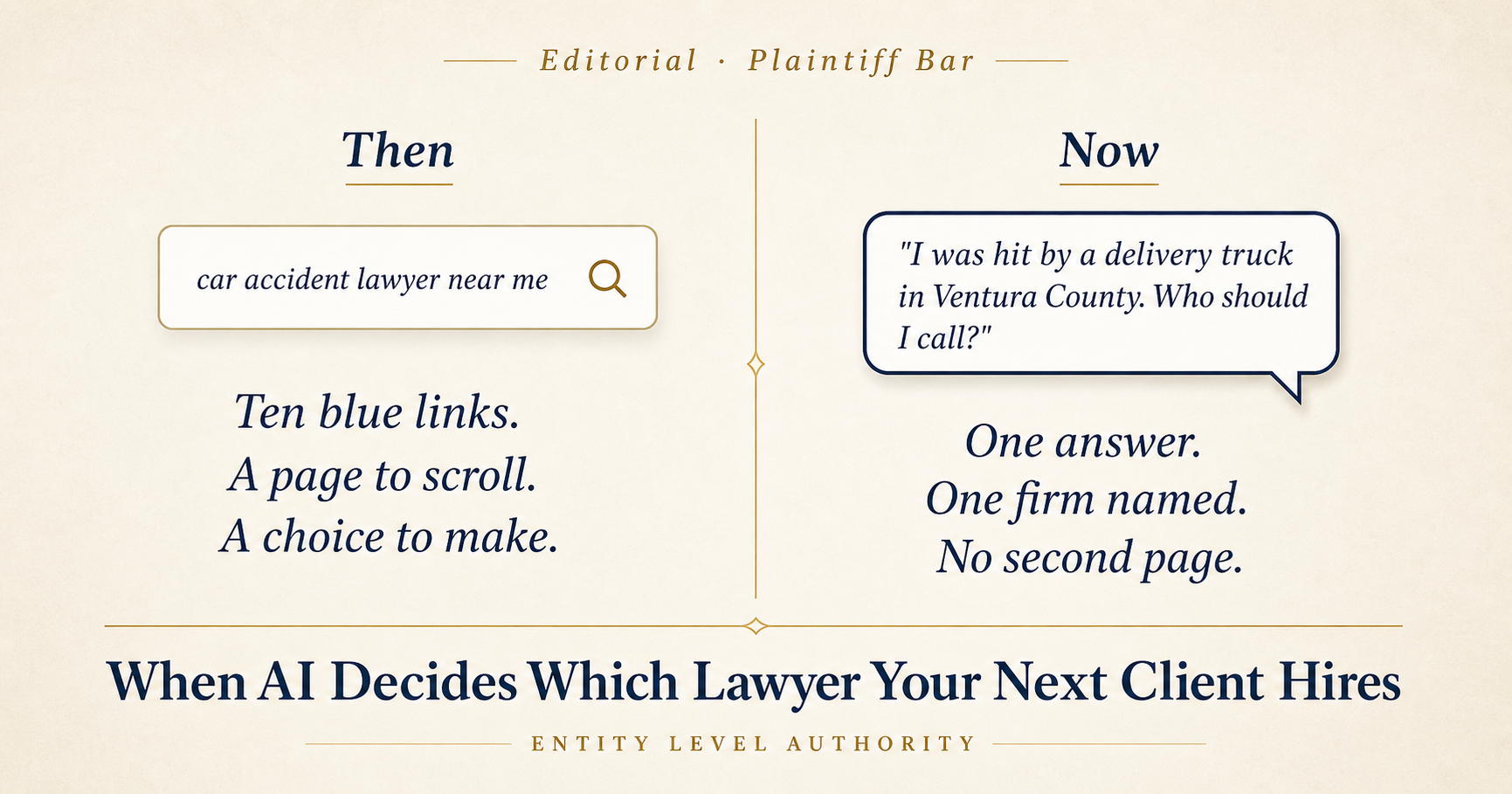
Someone gets rear-ended on the 405. They're sore, shaken, and not sure what to do next. Ten years ago, they might have asked a friend, opened a phone book, or typed "car accident lawyer near me" into Google and scrolled through blue links.
Today, nearly half of all searches receive an AI-generated answer instead of a traditional list of search results. At the same time, more people are opening ChatGPT, Perplexity, Gemini, Claude, and other large language models and asking questions in plain English.
They are not typing keywords. They are asking questions like:
"I was hit by a delivery truck in Ventura County. Who should I call?"
Did you know that many (1 in 3) local businesses are effectively invisible to AI search tools because of how their websites are structured, how their information is presented, or how little verified data exists about them online? AI search traffic to business websites has grown dramatically (500%+ last year), but AI answers also create a new zero-click problem: if the AI gives the answer directly and your firm is not cited, the prospect may never reach your website.
(Sources: Gartner, BrightEdge, SEMrush, Search Engine Land.)
AI answers questions, not just keywords. It names firms based on trust, credibility, structured information, and verified data. It does not name yours unless something specific has happened — unless your firm has been recognized as an authoritative entity inside the systems these models draw from.
This is the part plaintiff trial lawyers have not audited. And it is the part that may quietly determine whether the next serious case walks into your office or someone else's.
________________
The Shift Nobody Announced
For thirty years, search visibility was about ranking keywords. You optimized a page, earned some links, and waited to see where you landed on Google.
That game still exists, but a different kind of competition has started underneath it. AI models do not rank pages the way Google ranks pages. They synthesize information across many variable sources to validate what they say. They read across websites, directories, legal profiles, news mentions, structured data, and other public signals. Then they decide which law firms appear credible enough to include in a single answer.
If your law firm appears to be a trusted entity with consistent, verified data, you have a better chance of being named. If you do not, you may be left out.
There is no second page to scroll to. There may be no additional keyword search. There is the answer, and then there is silence.
________________
Why Plaintiff Firms Are Especially Exposed
Plaintiff work depends on inbound demand. Defense firms have institutional clients, panel relationships, and repeat corporate work. Plaintiff firms need injured people and families to find them at the exact moment they are looking for help.
Three things make plaintiff law firms unusually vulnerable to this shift
The cases are urgent. People hurt in a crash or harmed by a product are not running a six-month vendor evaluation. They ask, they get an answer, and they call.
The decision is emotional. They want to feel that the law firm they call is the right firm. AI's confident, conversational tone can give them that feeling quickly.
The competition is invisible. You do not see which firms the AI is naming instead of yours. Most attorneys have never run the test.
________________
The Test
Open ChatGPT. Open Perplexity. Open Gemini. Ask each one the question a hurt person in your jurisdiction would actually ask:
"Who is the best plaintiff trial lawyer for [your practice area] in [your county]?"
Read what comes back. Note which firms are named. Note whether yours is among them.
If your firm appears, look at the context. Is the AI describing you accurately? Is it citing a source you would want a prospective client to read? Is it mentioning verdicts, recognitions, trial experience, or practice strengths that actually reflect your firm?
If your firm does not appear, that case may have gone to someone else.
________________
What's Actually Going On
AI models do not simply invent these recommendations. They draw from a layered picture of your firm built out of public signals — your website, how it is structured, what other reputable sources say about you, how often your name appears in legal context, whether your data is consistent across the places it appears, and whether the model can understand who you are, where you practice, and what kind of cases you handle.
The technical specifics matter, but the takeaway for a busy attorney is simple: the firms being named are the firms whose digital footprint reads, to an AI system, as a coherent, credible, well-attested entity.
That is a fixable condition. But it has to be diagnosed first.
________________
We Ran the Audit on Ourselves
Before recommending this to plaintiff firms, we tested it on EntityLevelAuthority.com. We moved the AI Search Visibility Score from 37 to 65 in one day. Perplexity and Gemini began recognizing Entity Level Authority as a distinct entity. ChatGPT had not yet caught up at the time of testing — which is itself a useful data point about how these models update at different speeds.
Read the Phase 1 AI Search Visibility Case Study, including the AI test screenshots and description of the remediation work performed.
NOTE: The point is not the score. The point is that the gap is measurable, the fix is concrete, and the timeline can be days, not weeks or months.
________________
What to Do Now
You do not need a marketing team to start. You need five minutes.
Run a free complimentary AI Audit here: Request Your Complimentary AI Search Visibility Audit
Check to see what your visibility gap is, where the gaps are, and what to address first.