---
Most conversations about AI search visibility treat it as one problem. Get cited by ChatGPT. Show up in Perplexity. Rank in Gemini. In practice, the firms that struggle to appear in AI answers are struggling with one of two different problems, and the two problems are fixed by completely different kinds of work. Spending money on the wrong one is one common reason an AI visibility budget produces little or no measurable progress.
The diagnostic question is this: when an AI crawler arrives at your site, can it read route-specific content? Or can it read your content but fail to figure out who you are?
The First Kind of Problem: The Crawler Can't Read You
A lot of modern law firm websites are built as JavaScript applications. The page in your browser looks rich and substantive, but if you view the page source — the raw HTML that arrives before any JavaScript runs — you'll see a near-empty shell. Content gets painted in by JavaScript after the page loads in a real browser.
The problem is that many AI crawlers don't behave like real browsers. They request the page, read the initial HTML response, and move on. They don't execute the JavaScript. Sometimes they do, sometimes they don't, sometimes they do it inconsistently across pages. The result is that every URL on the site can return the same empty shell from the crawler's perspective. Your truck accidents page, your premises liability page, your homepage — all identical to the crawler. There's nothing route-specific for an AI system to cite, because the route-specific content was never in the response the crawler received.
This is what we call a Layer 1 problem — a retrievability problem. The fix is architectural: server-side rendering, pre-rendering specific routes, or serving crawler-targeted HTML at the edge. The work is engineering work. It happens once. When it lands, the difference is large and fast.
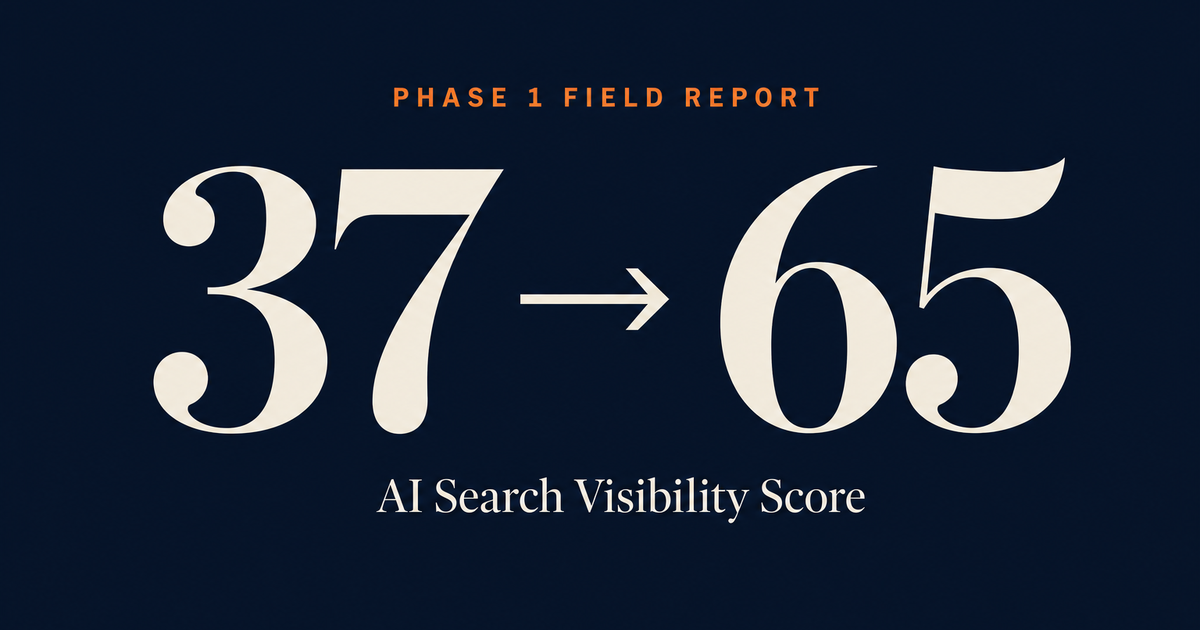
Our own first case study documents this. When we audited our site at the beginning of May, the score was 37. After the architectural fix landed, it was 65 by the next day. A 28-point move in one day, because what changed was that the crawler could finally read content that had always been on the page — just never in the response it received.
The Second Kind of Problem: The Crawler Can Read You, But Can't Place You
The second kind of problem is more subtle. The crawler reads the site fine. The content is there. But when an AI system tries to figure out who the firm is, what they do, and which third parties corroborate the claims, the answers are diffuse.
Common signs: no canonical identity page that carries the firm's name, address, telephone, and links to authoritative external profiles in one place. Practice-area pages that are short and generic rather than substantive and specific. Articles without clear author attribution. Schema markup that's present but sparse — an Organization block with no `sameAs` links, no Person entities, no FAQPage data on the practice pages where direct-answer queries would retrieve.
A site can be technically perfect and still leave AI systems uncertain about its identity. Uncertain systems cite cautiously, or not at all. The work to fix this is different in shape from the architectural work. It's content and structured data. It's expanding thin pages, adding authorship, building focused topic pages instead of relying on generic services overviews, adding sameAs links to bar association listings and court directories. The work is slower. It does not produce 28-point score movements in a day. It produces compound gains over weeks and months.
This is what we call a Layer 2 problem — an entity recognition problem. Most firms with reasonable websites have Layer 2 problems.
Why This Distinction Matters
The two kinds of problems require different kinds of vendors, different kinds of budgets, and different kinds of timelines.
If you have a Layer 1 problem and spend your AI visibility budget on more content, you may see little progress. The content is being painted into HTML the crawler isn't reading. Adding more invisible content does not make the existing invisible content more visible.
If you have a Layer 2 problem and you spend your AI visibility budget on a platform migration to a server-rendered framework, you will also get little. Your content was already crawler-visible. What was missing was the entity clarity that lets an AI system confidently identify and cite your firm. A new framework does not fix that.
Most firms guess at which problem they have, or rely on a vendor's intuition. The diagnostic is actually testable: check whether your route-specific content appears in the initial HTML response when a non-JavaScript crawler hits your site. If it doesn't, you have a Layer 1 problem. If it does, and you're still not getting cited, you have a Layer 2 problem. Sometimes you have both, in which case the order matters — Layer 1 work has to land before Layer 2 work produces leverage.
There's also a third layer — what an AI system actually decides to cite in a specific session, given a specific prompt and the model's own internal grounding. No vendor controls Layer 3 directly. What we can do is make Layers 1 and 2 strong enough that, when an AI system is choosing between sources, your firm is a credible option.
Where Our Own Work Is Now
We've documented this in two case studies on our own site. The first documents a Layer 1 fix — the 28-point move from architectural work alone. The second, published this week, documents what happened next: additional architectural work to extend retrievability across more routes, infrastructure to publish further reference content, and a four-point composite score gain that was smaller than the first move for a specific reason. The reason matters: our Layer 1 work was near its ceiling. The remaining drag on our score is Layer 2 work. The framework that explains why is here.
The next phase of our own work — Phase 3 — is Layer 2 work on our own site. We expect a different shape of result than Phase 1 produced. The architectural curve has flattened. The entity curve has not yet started moving.
This is the work that's coming, on our site and on our clients' sites. The firms that will win in AI search over the next 12 to 24 months are the ones that diagnose correctly, fix Layer 1 quickly when it's binding, and commit to the slower Layer 2 work that turns a retrievable site into a citable one.
If you're not sure which kind of problem your firm has, that's exactly what our AI Search Visibility Audit identifies. The audit measures Layer 1 mechanics and Layer 2 entity signals directly from public HTML, sub-score by sub-score, so the diagnosis is concrete rather than speculative.
The full framework underlying this article is at The Three-Layer Model. The case studies documenting how the framework plays out on our own site are at Phase 1 and Phase 2.