Most law firm marketing still treats search as a keyword problem: pick the phrase, write the page, win the ranking. A quietly important Google patent suggests that mental model has been narrowing for years — and it offers a useful lens on why conversational, context-dependent search now behaves the way it does.
The patent is "Context-Based Natural Language Processing," US 10,482,184 B2, granted November 19, 2019, with a priority date of March 8, 2015 and an adjusted expiration of November 5, 2036. Its inventors — Ilya Gelfenbeyn, Artem Goncharuk, and Pavel Sirotin — founded Speaktoit (later API.AI), the conversational-AI company Google acquired and rebuilt into Dialogflow. It was assigned to Speaktoit in 2016 and to Google LLC in 2017, and the family is still active: continuation patents issued in 2022 and 2024, with another application pending. It reflects technology from the Speaktoit/API.AI lineage — useful historical evidence of how Google-acquired conversational systems modeled entities, intents, and context. It does not disclose the current architecture of Google Search.
For plaintiff and trial lawyers — who compete in some of the most expensive, most local, and most emotionally loaded queries on the internet — the patent is worth understanding for what it illustrates, not what it proves. ELA reads it as a planning analogy: entities, intents, and prior-turn context have long mattered in conversational-system design, and that framing informs how ELA helps firms make each practice area clearer to modern retrieval and AI systems. The patent does not prescribe an SEO model — that interpretation is ELA's.
What the patent actually describes
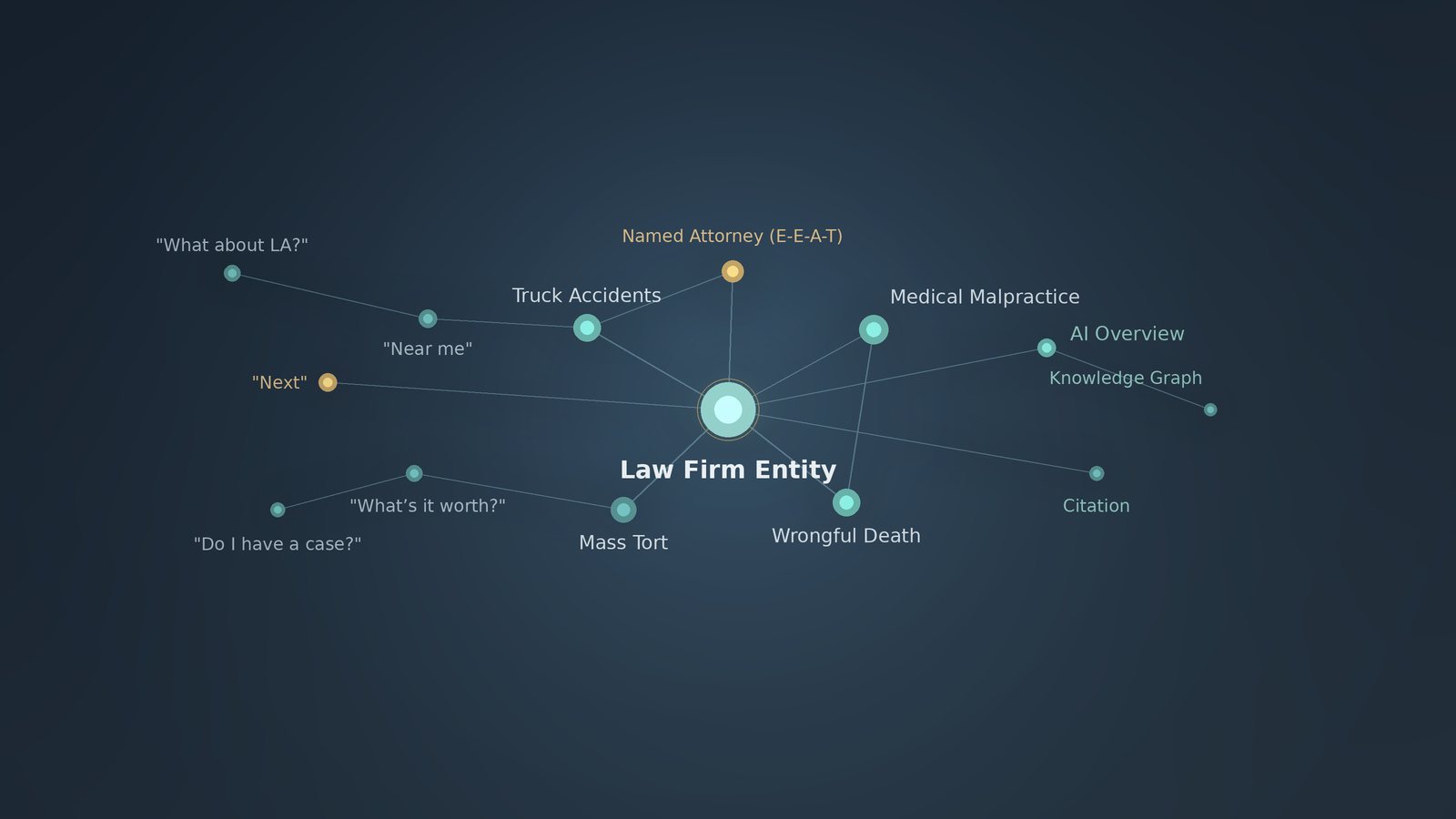
The patent solves a specific problem: conventional systems process each query in isolation, so they fail on requests that only make sense in context. The example from the patent itself is a two-step exchange. First a user asks, "What is the weather like in New York?" The system answers. Then the user asks, "What about Los Angeles?" A naive system recognizes "Los Angeles" but has no idea what the person wants done with it. Other failure cases the patent names: a bare command like "Next," or a time question asked after the user has crossed time zones.
The fix is a system the patent calls a Dialog System Engine. Developers build it by defining three things:
- Entities — lists of objects that share a class, each with a canonical value and a set of synonyms. The patent's examples include a "city" entity and an "artist" entity. Think of an entity as a thing the system knows about, plus all the ways people refer to it.
- Intents — rules expressed roughly as [Action]@[Entity]. "Play @Artist" or "[Weather]@[City]" are the patent's own illustrations. An intent connects what the user wants done to the entity it should be done to.
- Context — both conversational context (the sequence of prior requests and answers) and environmental context (geolocation, device type, time, weather, motion, the app currently open, the user's profile).
At runtime the engine receives the request plus those device and environment attributes, decides which kind of context applies, assigns a context label (for example "Weather," "Navigation," or "Create Email"), then selects the matching dialog rule tied to that label and generates either a linguistic response (an answer) or a fulfillment response (an action — schedule the meeting, build the route, send the message). Context labels even have a lifespan; they expire after a set time or number of turns, or when the user says "Cancel." Crucially, the engine resolves an unrecognized fragment like "what about" by reaching back into the context tied to the rule it just applied.
Why a conversational-AI patent is relevant to a personal-injury website
It's fair to ask why a patent about voice assistants should inform how a trial firm builds its site. Two reasons.
First, the behavior is no longer confined to assistants. AI Mode now supports follow-up questions and conversational refinement, which makes the patent's treatment of contextual, prior-turn-dependent requests conceptually relevant to how people search today. But Google has not confirmed that AI Mode or AI Overviews implements this patent, and nothing here establishes that generative search runs on the patented architecture. The patent anticipated a now-familiar mode of interaction — follow-up questions whose meaning depends on earlier turns — without that similarity proving anything about Google's current implementation. Treat it as directional context for how conversational systems have long been designed, not as a description of today's ranking.
Second, legal search is unusually conversational and unusually context-dependent. A real searcher's session looks less like one keyword and more like a dialog:
"Do I have a case if I got hit by a delivery truck?" → "What's it worth?" → "What about if it was a company driver?" → "Find a lawyer near me."
Every one of those follow-ups is an underspecified utterance of exactly the kind the patent was built to resolve — using the prior turn plus the searcher's environmental context. Firms with clearly differentiated, well-evidenced practice-area content give retrieval and generative systems better material for recognizing when the firm is relevant to that resolved context. That improves the evidence available; it does not guarantee selection, citation, or recommendation.
Why ELA treats each practice area as its own entity
Here is where ELA's methodology departs from typical legal SEO. Many firms build one "personal injury" presence and assume it covers everything. ELA instead treats each material practice area as a distinct service identity with its own content footprint. The patent doesn't prescribe this — it's ELA's strategic interpretation of a broader principle the patent illustrates: that a system resolving a request distinguishes among specific entities, defendant types, jurisdictions, and context rather than a single generic label. Applied to a law firm, that argues for clearly differentiated practice areas rather than variations on one keyword.
- Truck accidents. The relevant subject matter is commercial-vehicle and regulatory: motor carriers, FMCSA hours-of-service rules, electronic logging devices, black-box data, and the trucking-company defendant behind the driver. The context is heavily local and venue-specific, and the disambiguating follow-up is often "car versus truck." The page should aim to present the firm clearly as handling commercial trucking litigation in its jurisdiction, distinct from general car-accident work.
- Medical malpractice. This content combines legal and medical subject matter — high-trust, "Your Money or Your Life"–sensitive territory — which makes accuracy, qualified authorship, source quality, and clear attorney accountability especially important. Named attorney authorship, verified credentials, accurate descriptions of experience, and properly qualified case results help users and machines evaluate the source.
- Mass tort. The subject matter centers on products: a specific drug, device, or chemical, often tied to a named MDL or active litigation. Mass-tort search often has a stronger national, product-specific component than conventional local personal-injury search — product-name-driven queries ("is there a lawsuit for [product]"), a long eligibility chain, deadline sensitivity — though local and state-specific considerations may still matter.
The same logic extends to wrongful death, premises liability, product liability, and other lines. In ELA's approach, each priority practice area gets a clearly differentiated service description, appropriate structured data where supported, a focused content cluster, and internal links showing its relationship to the firm and relevant attorneys — not because Google requires separate schema per practice area, but because clarity helps both readers and machines.
The entity clarity takeaway
The patent's notion of an "entity" — a canonical thing plus its synonyms — is a useful analogy for why ELA emphasizes entity clarity over keyword repetition. In the patent's dialog system, a request is matched not as a raw string but, through context, to a known object. ELA applies that as a planning model: aim to be a clearly defined, well-corroborated source for each priority practice area, rather than a page repeating a phrase.
- Establish the firm as a recognized entity: consistent name, address, and phone across the web; a complete, verified Google Business Profile; and Organization plus Attorney / LegalService schema with a sameAs block pointing to your Bar profiles, Justia or Avvo listings, LinkedIn, and Wikidata where applicable. The goal is to give search and AI systems consistent, corroborated information about the firm — not merely another page targeting a phrase.
- Differentiate each priority practice area as a defined concept — clearly bounded, internally linked, and supported with the synonyms and related terms a reader (or a context-aware system) would expect to find clustered together.
- Bind practice areas to geography (except where the area is national, like mass tort). City- and venue-specific pages that genuinely describe local courts and statutes of limitation help associate the firm with the location a "near me" query implies.
- Name and connect your attorneys. Individual lawyer profiles — with credentials, accurately described experience, bar admissions, and authorship — strengthen how clearly the firm reads as a source, and support the trust signals that matter in legal.
The GEO takeaway
GEO is about being a source a generative engine assembles its answer from, and cites. This patent — and general practice — point to several concrete moves:
- Write for query chains, not single queries. Anticipate the follow-up. A page that answers "do I have a case?" should also resolve value, timeline, fees, and what counts as your type of case — so an engine can satisfy a multi-turn session from your content.
- Answer underspecified questions explicitly. Clear comparisons between accident or injury types, and clear "if X then Y" structures, give an engine clean material to resolve a vague follow-up.
- Make fulfillment frictionless. The patent distinguishes answers from fulfillment actions. When a searcher's intent is "contact a lawyer," your click-to-call, directions, and intake forms are the fulfillment — surface them where the reader can act immediately.
- Earn corroboration. Modern search and generative systems may weigh many relevance and quality signals when deciding what to surface and cite. Independent references, reputable links, consistent profiles, and coherent first-party information can strengthen the overall evidence around a firm. The patent describes machine-learning classifiers selecting dialog rules; it does not specify how Google weighs links, reviews, or external authority — so treat this as general GEO practice, not a patent claim.
Where this leaves trial lawyers
The firms that fare best in the next phase of search are likely to be the ones search and AI systems can clearly recognize — per practice area — with consistent information and corroboration that helps an engine understand when the firm is relevant to a messy, multi-turn, location-aware question. The patent illustrates that kind of context resolution; it does not prove Google runs on it. Entity, links, and authority aren't three separate projects; they're three views of one goal: becoming a clearly recognized, well-evidenced source for your practice areas, in your venue.
Get a complimentary ELA audit
Want to know how clearly Google and AI systems can recognize your firm and its priority practice areas? Request a complimentary ELA audit. We'll evaluate your firm's priority practice areas, identify entity, content, relationship, and authority gaps, and provide a prioritized remediation plan to make your firm clearer to modern search and AI systems. Schedule your free ELA audit today.
Frequently asked questions
Does this patent mean keywords no longer matter for law firm SEO?
Keywords still describe what a page is about. The patent describes a dialog system resolving requests by matching them, through context, to recognized entities rather than raw strings — a useful illustration, though it does not describe Google's live ranking. ELA's takeaway for trial firms is to invest in being a clearly defined, well-evidenced source for a specific practice area and location, not only in ranking a single keyword page.
What is entity optimization for a law firm?
It is making your firm, your attorneys, and each practice area legible as defined things search and AI systems can understand: consistent name, address, and phone; a verified Google Business Profile; Organization and Attorney schema with sameAs links to bar and directory profiles; and content that treats each practice area as a bounded concept rather than a keyword.
Why does each practice area need its own optimization?
Truck accident, medical malpractice, and mass tort cases involve different subject matter and context — local commercial-vehicle disputes, clinical standard-of-care questions, and national product or drug litigation respectively. A single generic personal injury page is unlikely to read clearly as the right source for all of them, so ELA gives each priority area its own differentiated service description, appropriate structured data where supported, and focused content.
Is FAQ schema still worth adding after May 2026?
Google stopped displaying FAQ rich results on May 7, 2026, so the markup no longer earns that search feature. FAQPage remains a valid Schema.org type, and existing valid markup does not need to be removed, but Google has not said FAQ markup improves AI citations or generative-search visibility. Keep useful question-and-answer content for readers and retrieval clarity, not because the markup is known to give a GEO advantage.
What is the difference between SEO and GEO for trial lawyers?
SEO aims to rank a page in a list of links; GEO aims to be a source a generative engine uses and cites when it assembles an answer. The patent's depiction of resolving a multi-turn, context-dependent request is conceptually closer to the GEO mindset than to classic keyword ranking — a useful framing, though it does not dictate which source an AI engine actually selects.
Source notes
Primary source: "Context-Based Natural Language Processing," US Patent 10,482,184 B2, US Patent and Trademark Office / Google Patents — granted November 19, 2019; priority March 8, 2015; adjusted expiration November 5, 2036; assigned to Speaktoit, Inc. (2016) then Google LLC (2017); active family including US 11,232,265 B2 (2022), US 12,008,325 B2 (2024), and a pending application. Commentary and patent surfacing: Olaf Kopp, kopp-online-marketing.com.
This article uses the patent as historical and conceptual context only. Patents describe methods a company may use; they are not evidence of current Google Search, AI Overviews, or AI Mode ranking behavior. Nothing here promises rankings, citations, recommendations, or any specified improvement in AI visibility.