Artificial intelligence is changing how prospective clients, referral sources, journalists, legal professionals, and other members of the public discover and evaluate law firms.
Traditional search engines generally direct users toward a collection of webpages. AI systems increasingly attempt to provide the answer themselves. They may summarize a firm's services, identify its attorneys, describe the jurisdictions or communities it serves, compare it with other firms, and determine whether it appears relevant to a particular legal matter.
That shift creates both an opportunity and a significant accuracy problem.
A plaintiff law firm may have an established website containing attorney biographies, practice-area pages, office information, case results, articles, FAQs, and other evidence of its experience. Yet the relationships among those materials may not be stated in a form that an AI system can consistently interpret. The system must often infer which attorneys belong to the firm, which locations are actual offices, which communities are merely service areas, and which legal services the firm currently offers.
That is why the development of EntityMap is important.
Recognizing the EntityMap Contributors
Entity Level Authority, or ELA, recognizes and thanks Fred Laurent, Dixon Jones, Waikay/InLinks, and the other contributors who initiated, developed, supported, tested, and brought public attention to EntityMap.
EntityMap advances a straightforward but consequential idea: a website should be able to provide machines with more than a list of URLs. It should also be able to publish a structured description of the entities it covers, the relationships among those entities, and the source material supporting those representations.
A conventional XML sitemap can help a crawler discover that a law firm website contains 200 pages. It does not necessarily tell the crawler that:
- the organization identified on the homepage is the same firm represented on the contact page;
- a particular lawyer is an attorney affiliated with that firm;
- "truck accident litigation" is a practice area offered by the firm;
- a city is an office location rather than merely a market served by the firm;
- an attorney biography supports the relationship between the lawyer and the law firm; or
- a particular page is the firm's principal source of information concerning a legal service.
EntityMap is intended to provide that additional semantic and evidentiary layer. Instead of merely declaring that pages exist, it allows the publisher to identify what the site knows, how the relevant subjects are connected, and where the supporting content can be found.
This work has helped move the concept from theory into a practical discussion about how organizations may communicate their identity and knowledge to AI systems. Published implementation materials and testing have also encouraged the AI-visibility industry to consider an important question: should organizations continue allowing machines to reconstruct their identities from scattered webpages, or should they provide a clearer, publisher-controlled map?
ELA believes plaintiff law firms should be able to provide that map — but only when the underlying information has been reviewed and substantiated.
Why Plaintiff Law Firms Require Additional Safeguards
A law firm is not merely a commercial brand. Its website may contain factual representations concerning attorneys, professional affiliations, office locations, admissions, credentials, legal services, jurisdictions, results, and other matters that require particular care.
For that reason, ELA does not treat EntityMap generation as a routine exercise in automatically converting crawl data into JSON.
A crawler can collect information. It cannot always determine whether that information should be published as an authoritative representation of the firm.
Consider several common examples.
A former attorney may still appear in an old article, PDF, press release, or cached biography. A crawler may interpret that person as a current member of the firm.
A law firm may publish a page optimized for a city where it accepts cases but maintains no physical office. An automated system may incorrectly classify that city as an office location.
Attorney schema may identify one version of a lawyer's name, while a biography, professional directory, or page title uses another. Without reconciliation, a machine-generated map could create duplicate attorney entities.
A practice-area page may mention medical malpractice as part of a general discussion while the firm does not actually accept medical-malpractice matters. A simplistic extraction process could mistakenly represent that subject as an offered service.
Two pages may contain conflicting addresses, telephone numbers, firm names, or organizational relationships. Selecting one automatically may convert an unresolved inconsistency into a published factual assertion.
In the legal profession, these are not merely technical imperfections. They can affect consumer understanding, professional reputation, referral decisions, advertising accuracy, and the firm's control over its own identity.
ELA's enhancement is designed around that distinction.
ELA's Evidence-Governed EntityMap Enhancement
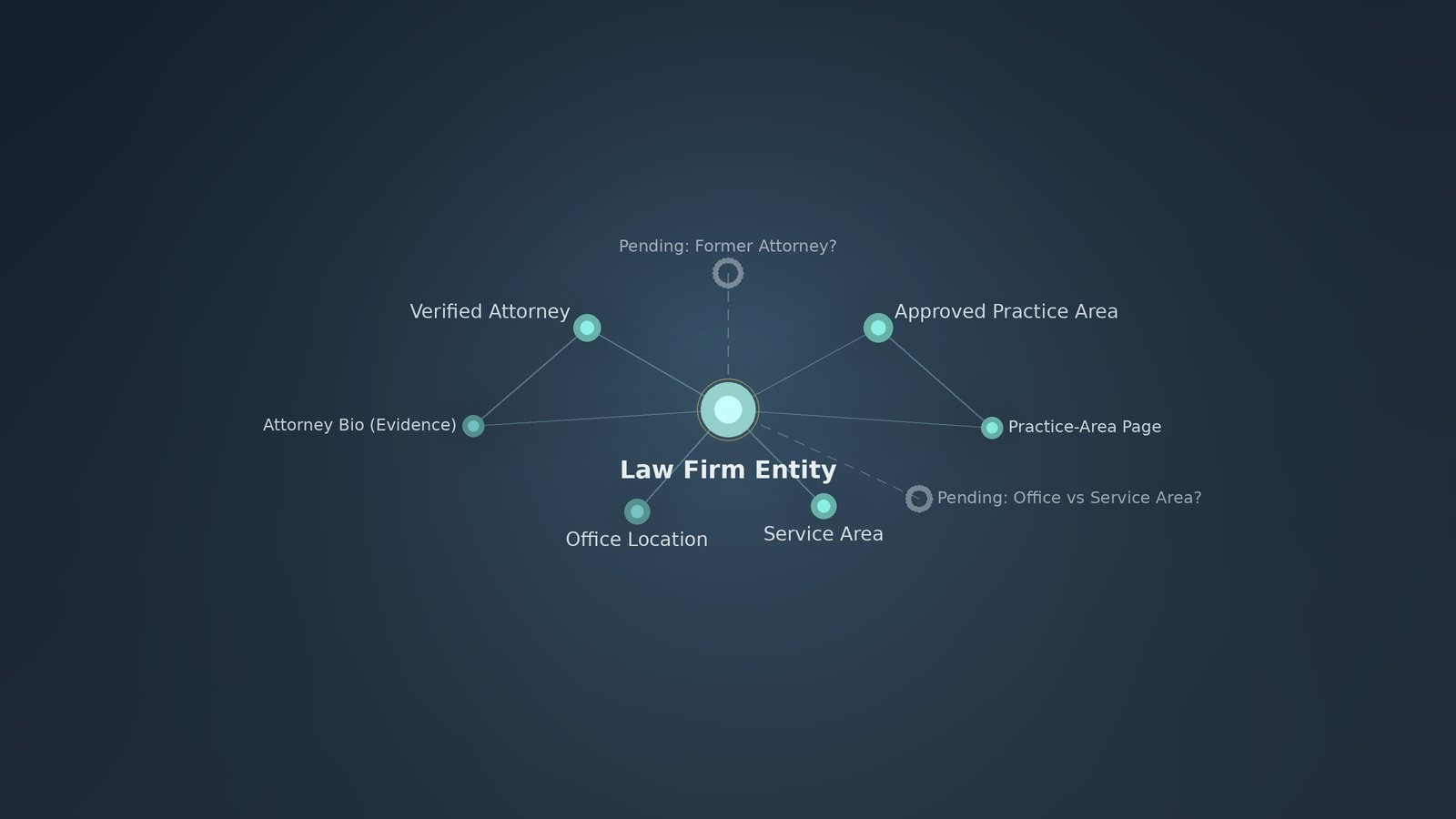
ELA is developing an EntityMap workflow specifically for plaintiff law firms. Its purpose is to create a clear, verified map of the law firm, including:
- the law firm as the principal organization;
- its supported practice areas;
- its verified attorneys;
- its actual office locations;
- separately identified geographic service areas;
- its important webpages and evidence sources; and
- the relationships connecting those elements.
The map is created from evidence collected and evaluated during an ELA audit. It is not created merely by asking an AI model to summarize the website.
ELA's audit examines relevant site content and structured data to identify candidate entities and relationships. Those candidates may include the law firm's canonical identity, attorney names, practice areas, office addresses, service-area references, attorney biography pages, contact pages, practice-area pages, and other important resources.
The audit evidence then supports a controlled review process.
Information that is sufficiently clear and supported may become eligible for approval. Information that is incomplete, contradictory, ambiguous, or unsupported remains outside the deployable EntityMap.
This distinction between a candidate fact and an approved representation is central to the ELA approach.
A crawl result is evidence to be considered. It is not automatically the final word.
The Firm as the Controlling Entity
For most plaintiff law firm implementations, the law firm should function as the principal organizational entity.
Practice areas, attorneys, offices, service areas, and important pages should be connected to that organization through explicit, supportable relationships.
For example, the EntityMap may represent that:
- the firm offers a specified legal service;
- an approved attorney works for or is affiliated with the firm;
- an office location belongs to the firm;
- the firm serves a defined geographic area;
- an attorney biography is an authoritative page concerning that attorney; and
- a practice-area page is an important source concerning the firm's handling of a particular category of cases.
These relationships should not be inferred merely because two names appear on the same website. ELA seeks supporting evidence for the connection.
An attorney's biography, organizational schema, team page, and consistent references across the site may collectively support an affiliation. A complete address presented on the contact page and in consistent structured data may support an office relationship. A dedicated service page, navigation placement, descriptive content, and related site signals may support a practice-area relationship.
Where the evidence does not establish the relationship with sufficient clarity, the matter is held for review.
Attorney Verification and Conflict Prevention
Attorney identity is one of the most sensitive components of a law firm EntityMap.
ELA's workflow is designed to prevent uncertain attorney names from being published automatically. Candidate attorney information may be compared across biography pages, schema, team pages, URLs, professional titles, organizational references, and other available evidence.
The system may detect that multiple references appear to describe the same attorney. It may also identify competing or incomplete relationships that require human judgment.
For example:
- Does the person currently practice with the firm?
- Is the person an attorney, consultant, co-counsel, former partner, or staff member?
- Does the biography clearly identify the person's relationship to the firm?
- Are two similar names separate individuals?
- Does a structured-data reference conflict with the visible page?
- Is an attorney associated with a particular office, the entire firm, or neither based on the available evidence?
ELA does not attempt to resolve every ambiguity by guesswork. Uncertain identities and relationships remain in the administrative review area until an authorized reviewer makes a determination.
Distinguishing Offices from Service Areas
Plaintiff law firms frequently serve clients beyond the cities in which they maintain physical offices. That distinction must be preserved.
An office is not the same thing as a service area.
ELA's enhanced workflow is intended to keep those concepts separate. A verified street address may be represented as a firm location. A city, county, or region targeted by a service page may instead be represented as an area served, provided the relationship is supported and approved.
This protects against a common source of confusion in legal marketing: the accidental representation of a geographic landing page as a physical office.
Where address evidence conflicts, is incomplete, or cannot be tied clearly to the firm, the location remains subject to administrative review rather than being incorporated automatically into deployable JSON.
Mapping Practice Areas to Supporting Pages
A useful EntityMap should do more than list broad legal terms. It should show how the firm's approved services connect to the pages that substantiate them.
For a plaintiff law firm, that may include relationships among:
- the firm;
- personal injury as a broader field;
- a specific practice area such as trucking accidents, premises liability, medical malpractice, wrongful death, or product liability;
- a principal practice-area page;
- related attorney biographies;
- relevant FAQs or informational resources; and
- approved geographic service relationships.
The objective is not to publish every term found during the crawl. It is to identify the practice areas that the firm actually presents as services and connect them to the strongest available first-party evidence.
Where a service is mentioned only incidentally, where the site contains contradictory signals, or where ELA cannot establish a reliable relationship, the practice-area candidate can be withheld pending review.
Human Authorization Before Deployment
The ELA workflow includes an administrative review layer between audit evidence and public deployment.
Information may be divided into practical categories such as:
- sufficiently supported and eligible for approval;
- incomplete or uncertain;
- conflicting;
- missing a required relationship; or
- unsuitable for publication without further evidence.
An authorized reviewer can examine the material, confirm important relationships, approve supported information, and reject or defer questionable candidates.
Only approved information is eligible to be included in deployable EntityMap JSON.
This process gives the law firm control over the machine-readable representation of its identity. It also creates a defensible distinction between what the crawler observed and what the firm ultimately authorized for publication.
ELA is therefore not proposing that raw crawl results be exposed as a public statement of fact. The audit creates the evidentiary record. The review process resolves material questions. The approved output becomes the deployable artifact.
A Controlled Statement, Not an AI Guess
The final objective is a machine-readable description that AI systems and crawlers can inspect without being required to reconstruct the firm's identity from disconnected signals.
The EntityMap can tell machines:
- who the law firm is;
- which organization is the controlling entity;
- which attorneys have been verified;
- which legal services have been approved;
- which addresses are actual firm locations;
- which geographic references are service areas;
- which pages provide the relevant supporting evidence; and
- how those entities and resources relate to one another.
EntityMap cannot compel an AI platform to accept, cite, or reproduce every representation. Nor does it replace accurate website content, structured data, professional review, or applicable legal-advertising obligations.
It does, however, provide the firm with a clearer way to state its identity and knowledge in a structured format controlled by the publisher.
Building on an Important Open Standard
The EntityMap contributors have helped establish an important foundation: websites should have a practical mechanism for describing their knowledge to AI systems in an entity-first, evidence-connected format.
ELA's contribution is to adapt that foundation to the particular realities of plaintiff law firms.
For legal organizations, the question is not simply whether an entity can be extracted. The more important questions are whether the entity is correct, whether the relationship is supported, whether conflicting evidence has been resolved, and whether an authorized person has approved the representation.
That is the purpose of ELA's enhancement.
The ELA EntityMap workflow is being built to transform audit evidence into a reviewed, controlled, and deployable description of the firm — not an automated publication of everything a crawler happens to find.
The result is intended to give plaintiff law firms a more reliable way to communicate their identity, attorneys, services, locations, service areas, important pages, and supporting relationships to machines.
In an environment where AI systems increasingly summarize businesses before users visit their websites, that control matters.
A plaintiff law firm should not have to depend entirely on an AI system's best guess about who it is, what it does, where it practices, or who belongs to the firm. It should be able to provide a clear, verified, and evidence-supported map. To see what your firm's verified map would look like, request a complimentary ELA audit.
Source notes
EntityMap v1.0 defines the project as an open, structured, entity-first index for AI systems, language models, agents, and retrieval pipelines. It distinguishes the entitymap.json file, which communicates what a site knows and how its entities relate, from a traditional sitemap that primarily identifies available pages (EntityMap Specification v1.0).
The official validator credits Fred Laurent as the initiative's originator, with support from Dixon Jones and Waikay/InLinks Optimization Ltd. The implementation guidance also identifies a reference generator that extracts candidate entities and evidence chunks to produce EntityMap files (EntityMap Validator v1.0).
This article describes an approach to communicating a firm's identity to AI systems. It does not promise rankings, citations, recommendations, or any specified improvement in AI visibility; published testing should be treated as case-study observation rather than a guaranteed outcome.