
Author: Paul J Bruemmer

Preface: The last article focused on how plaintiff attorneys can strengthen AI visibility using a strategic advantage in LLMO (Large Language Model Optimization) and GEO (Generative Engine Optimization). Now, let’s go one level deeper:
How can plaintiff attorneys influence how AI systems perceive and represent their brand? That’s where AI Knowledge Audits come in.
Brand Perception Is Critical
LLMs (Large Language Models) don’t browse the internet like humans do. Instead, they:
- Retrieve entity-based knowledge
- Use structured signals to ground (disambiguate) facts
- Rely on trusted source domains
Your name, law firm, reviews, specializations, and recognitions are not just web content — they’re data points AI models try to resolve as entities. If your entity is weakly defined, you’re invisible or misrepresented.
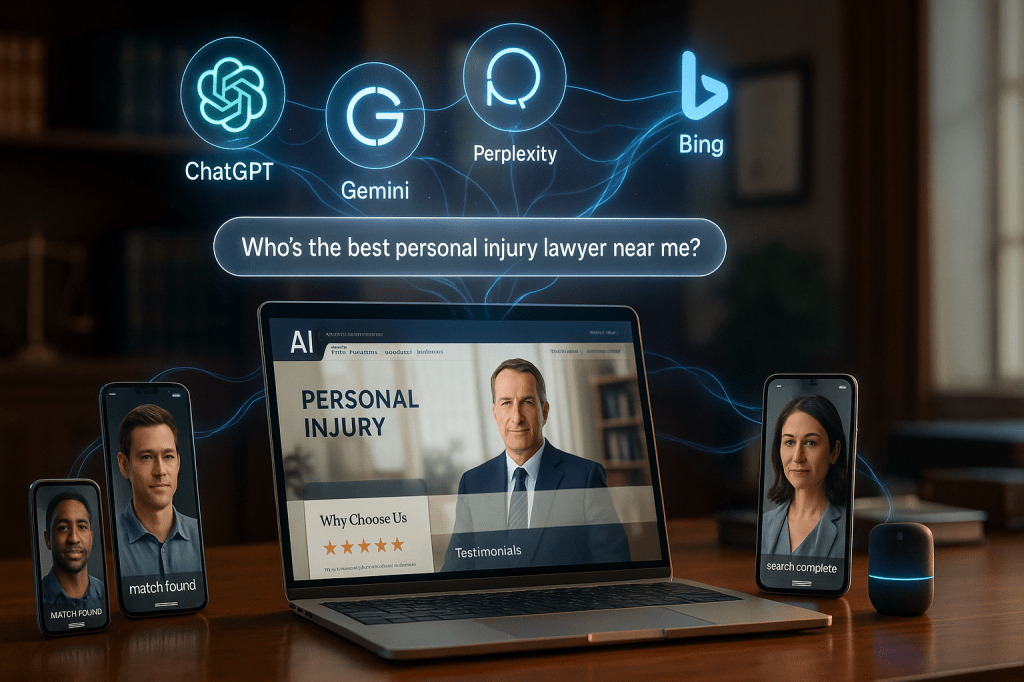
Generative AI tools like ChatGPT (Open AI), Sonar (Perplexity), Gemini (Google), and Claude (Anthropic) rely on entity resolution, semantic relevance, and trustworthy content to decide:
- What sources to retrieve
- Who to cite
- How to describe your brand
An AI Knowledge Audit helps you see yourself the way machines do—and allows you to strategically adjust your digital presence for maximum AI visibility and credibility.

Key AI Visibility Insights from an AI Knowledge Audit
As generative AI systems become central to how people find and trust information, tools like Waikay.io offer a deeper look into how well your brand and content are understood—and retrieved—by systems like ChatGPT, Perplexity, Gemini, and Claude. Here are the most valuable insights uncovered in a typical AI visibility audit:
1. AI Knowledge Score
AI models assign varying levels of familiarity and trust to different websites. Some platforms like ChatGPT, Perplexity may recognize and retrieve from your site frequently, while others like Gemini or Claude may not even include your data in their training sets!
2. Link Citations from AI Systems
AI models often cite or retrieve from websites based on structured signals and link references. A Waikay.io topic audit can reveal how AI tools like ChatGPT, Perplexity, Claude, or Gemini see your site compared to competitors.
3. Competitor Comparison
Your competitors may be more heavily referenced in AI systems simply because they’ve created content on topics that align better with LLM training data or retrieval relevance.
4. Topic Gaps
A Waikay.io topic audit uncovers:
- Critical gaps: Topics essential to your industry that are missing or poorly covered.
- Significant gaps: Topics competitors cover better or more thoroughly.
- Thematic gaps: Broader areas where your content lacks depth or context.
Tip: Use these insights to create high-impact content that fills these gaps.
To Do List

Enhance your digital presence by building clean, structured, and authoritative entity profiles.
Here’s how a topic report supports LLMO/GEO:
1. Entity Linking & Disambiguation
Ensure your brand (e.g., “XYZ Law Firm”) is properly linked across the web to avoid confusion with similar names or unrelated content.
Plaintiff Attorney Example:
Avoid being confused with “XYZ Legal Services” in another state.
2. Knowledge Graph Integration
Enrich your brand with structured data using Schema.org, Wikidata, and local business directories. This helps LLMs resolve your entity as trusted and grounded.
Example:
By tagging your site with LegalService, Attorney, and Person schema tied to a Google Knowledge Panel and LinkedIn profile.
Fact Check or Flag: “This is a verified law firm, specializing in personal injury, with authority in [Region].”
3. Contextual Brand Descriptions
LLMs use short summaries to describe entities. If your brand lacks one, or if it’s poorly written, you’ll be left out or misquoted in AI-generated content.
Write and publish AI-friendly brand descriptions that include:
- Area of expertise
- Geographic focus
- Track record or notable case types
Example:
Instead of “personal injury attorney,” your brand might resolve in AI like this:
Fact Check or Flag: “XYZ Law Firm is a Ventura-based personal injury firm known for multimillion-dollar verdicts in auto and workplace injury cases.”
What is Waikay?
Waikay is an AI visibility intelligence platform built to help brands monitor, measure, and manage how they’re perceived by leading generative AI systems such as ChatGPT (OpenAI), Sonar (Perplexity), Gemini (Google), and Claude (Anthropic).
It offers a strategic advantage by revealing how AI models interpret and present your brand across generative content and AI-driven search results. Additionally, it delivers a clear action plan for reviewing, verifying, and correcting brand-related facts and information.
Key Features & Benefits Include:
- AI Knowledge Score – Quantifies how well your brand is recognized and understood by major AI models, offering a snapshot of your overall visibility.
- Knowledge Sources – Reveals which external sources and links AI systems rely on when generating information about your brand.
- Competitor Benchmarking – Allows you to evaluate your brand’s AI presence against competitors, exposing areas where others may be gaining an edge.
- Knowledge Map – Visualizes how AI models associate your brand with relevant topics and entities, helping you understand your semantic footprint.
- Content Gap Analysis – Pinpoints critical, significant, and thematic content gaps that, if addressed, can strengthen your authority and retrievability in AI systems.
- Link Integrity Monitoring – Audits your link structure for broken or redirected URLs that may harm your credibility or reduce your chances of being cited by AI.
The Loop: How Waikay.io Audits Help Amplify LLMO/GEO Strategy

Real-World Scenario: Bringing It All Together
Let’s say you’re a plaintiff attorney in Ventura.
You publish a blog:
“What to Do After a Slip and Fall in Ventura County”
You apply Part 1 LLMO tips:
- Use semantic titles and structured FAQs
- Interlink related topics (e.g., liability, negligence laws)
- Add local statistics and cite sources
- Run an AI Knowledge Audit at Waikay.io and follow recommendations.
Result:
When someone asks Chat GPT, Sonar, Gemini or Claude:
“Who’s the best slip and fall attorney in Ventura?”
Your name appears — not because you bought an ad or ranked #1 — but because you’ve been grounded and disambiguated as a verified authoritative answer.
Why This Matters for Plaintiff Attorneys
Legal is a high-E-E-A-T (Experience, Expertise, Authority, Trust) vertical. AI systems are extremely cautious about which firms they cite or recommend.
Without proper grounding, your expertise won’t surface in generative AI — even if you’re the best in town.
Final Takeaway
In the new era of SEO:
- LLMO (Large Language Model Optimization) makes your content discoverable
- GEO (Generative Engine Optimization) makes your content retrievable by AI
- Waikay.io AI knowledge audits recommend a solid action plan
It’s not just about what you publish — it’s about how machines see and trust you!
If you’re a plaintiff attorney who wants to win not just Google rankings but AI recognition, it’s time to optimize both your content and your entity.
Disclaimer: The author is not affiliated with Waikay.io. The insights shared are based on over 30 years of hands-on SEO experience and ongoing analysis of emerging trends since 1994. Observations are independent and intended to help professionals navigate the evolving intersection of SEO, AI, and brand visibility.

 Mastering the New Digital Landscape for 2030 and Beyond
Leave a comment